TEXTBOOKS
Informational text
A 2018 meta-analysis of 54 studies with 171,055 participants found better comprehension on paper for informational texts, but not for narrative-only texts.
Check a task doodletextbooks
WHAT THE RESEARCH SAYS
For textbooks, the medium can matter.
SMALL GAP bigger when time is short
171,055 Participants across 54 studies, 2000 to 2017
Researchers have compared reading the same text on paper and on screens in dozens of experiments. Two large reviews found a small but steady advantage for paper with informational texts, and almost none for stories.
THE SHORT ANSWER
Screens are not bad for reading.
But for dense, factual texts the research leans towards print.
TEXTBOOKS
A 2018 meta-analysis of 54 studies with 171,055 participants found better comprehension on paper for informational texts, but not for narrative-only texts.
Check a taskSCROLLING
The paper advantage was larger under time limits than in self-paced reading. Studies that needed scrolling also showed a gap, though this was not a significant moderator.
See the numbersSTORIES
A 2019 meta-analysis found no difference with narrative texts, while expository texts favoured paper. Reading time was about the same on both.
What to tryA QUICK TASK CHECK
Pick a reading task to see what the meta-analyses found. The bar shows how strongly the evidence leans towards paper for that kind of task.
Based on Delgado and colleagues (2018) and Clinton (2019). These are averages across many studies, not predictions for any one reader.
FOUR THINGS TO TRY
The research does not say never read on a screen. It suggests where print is worth reaching for, and how to read better when a screen is all you have.
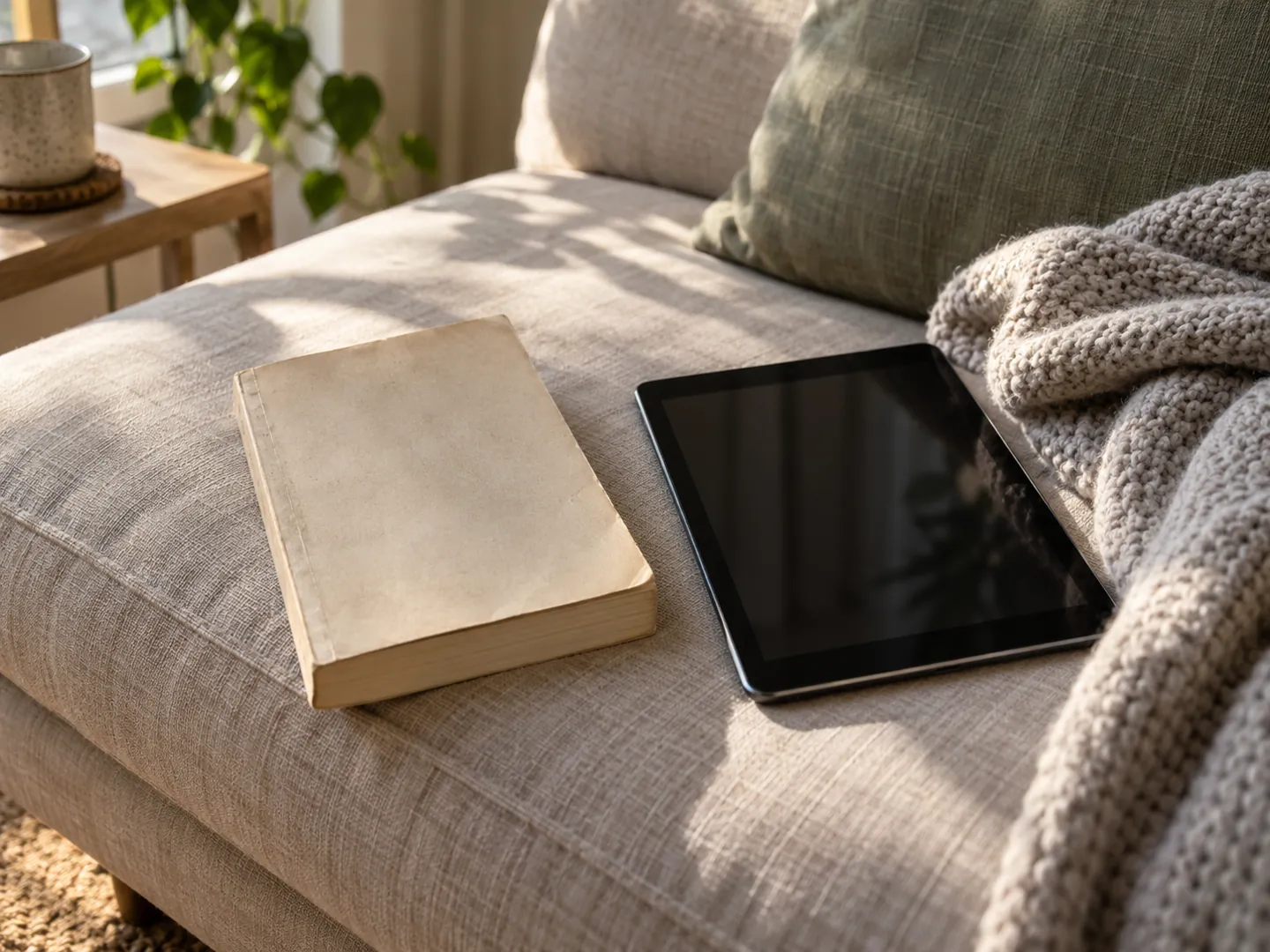
For dense, factual chapters you need to understand, paper had the clearest advantage in the reviews.
The screen gap was largest under time pressure. Slow, self-paced reading narrowed it.
In the 2018 review, studies on hand-held devices and studies without scrolling showed smaller gaps than computers and scrolling text.
Clinton found readers judged their own understanding less accurately on screens, so check with questions rather than confidence.
TWO NUMBERS WORTH KNOWING
How much evidence there is,
and how much the gap is worth.
171,055
Participants across 54 studies, 2000 to 2017
Both kinds of study design gave the same result: an advantage for paper over digital reading, with an effect size of 0.21.
SCALE · DELGADO ET AL. 2018
≈ ⅔ of a year
The gap compared with a year of primary-school progress
The authors note the effect is small by usual standards, but equals about two thirds of the yearly growth in comprehension in elementary school.
SIZE · DELGADO ET AL. 2018
The 2018 review also found the paper advantage grew between 2000 and 2017 and did not differ between age groups, so it has not faded as people use screens more.
WHY THE GAP MIGHT EXIST
The reviews do not prove a cause, but researchers point to a shallower, skimming style of reading on screens, sometimes called the shallowing hypothesis, shaped by quick everyday digital tasks.
A second idea is metacognitive: people tend to overestimate how well they have understood a text on screen. Clinton's 2019 review found readers' judgements of their own performance were better calibrated on paper.
Questions
For informational texts, two meta-analyses found slightly lower comprehension on screens. For stories, they found little or no difference.
Small. Delgado and colleagues report an effect size of 0.21 and Clinton 0.25. The 2018 authors note that is still about two thirds of a year's growth in reading comprehension in elementary school.
Clinton's 2019 review found no reliable difference in reading time between paper and screens.
The 2018 review found no difference in the media effect between age groups, and the paper advantage grew rather than shrank between 2000 and 2017.
Possibly. The paper advantage was significant with computers but not with hand-held devices, and with texts that needed scrolling, though neither was a significant moderator.
Updated
ABOUT THIS NAME
doodletextbooks.com is part of the DoodleSale portfolio. It isn't in an auction right now, but you can ask about leasing it.